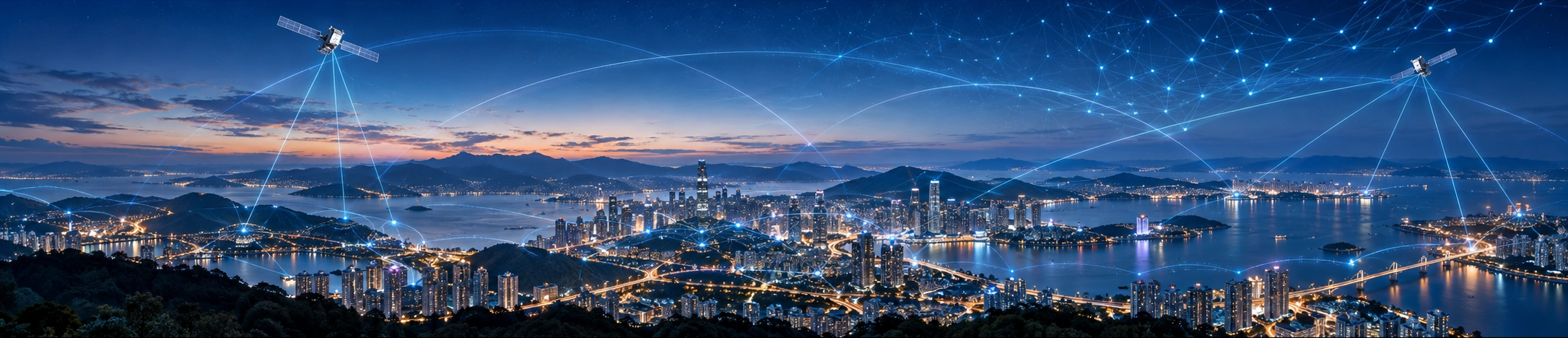
The Evolution of Emergency Communications: From Mobile Base Stations to Satellite Connectivity
1.0 | Traditional Emergency Communications: Vehicle-Mounted Base Stations
Since the 2G era, mobile network operators have relied on vehicle-mounted base stations to restore connectivity during network outages and provide additional capacity at major events.
These systems typically integrate cellular base stations, microwave backhaul equipment, generators, fuel storage, and telescopic antenna masts onto heavy-duty trucks.
They can be rapidly deployed to areas experiencing network disruptions or temporary traffic surges, with microwave links providing network backhaul. Today, they remain widely used for large public events, transportation hubs, and emergency network recovery.

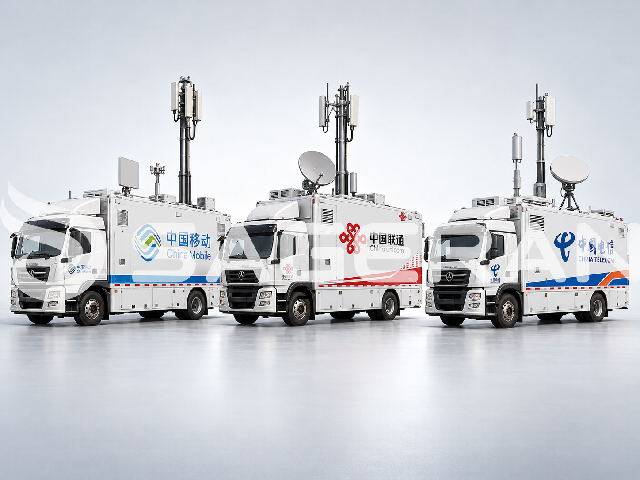
Their main advantages are high network capacity and extended autonomous operation. When equipped with satellite terminals, they can also operate independently of terrestrial backhaul infrastructure.
However, their size limits access to disaster zones where roads have been damaged or blocked. In such environments, compact, portable communication systems are essential for first responders and affected communities.
While rescue teams commonly use VHF/UHF handheld radios and portable repeaters, deployable cellular systems can help restore communications for the public, allowing residents to contact family members and request assistance.
2.0 | Modern Emergency Communications: Multiple Deployment Options
2.1 Portable Emergency Base Stations
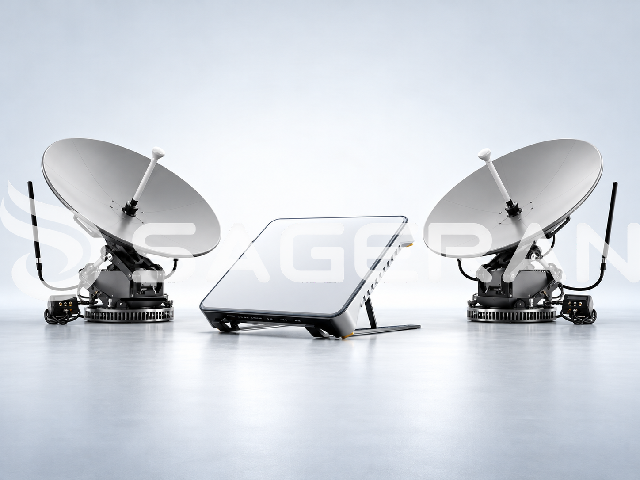
Portable emergency base stations typically combine a compact cellular base station with a portable satellite terminal.
The satellite terminal provides backhaul connectivity to the operator's core network, enabling cellular services in areas without terrestrial network access.
Depending on transmit power and deployment conditions, these systems can provide coverage ranging from 50 meters to approximately 1 km, with integrated batteries supporting around 4 hours of autonomous operation.
They are particularly valuable during the initial stages of disaster response, enabling basic communications, emergency calls, and information exchange between affected communities and rescue teams.
2.2 Tethered UAV Base Stations
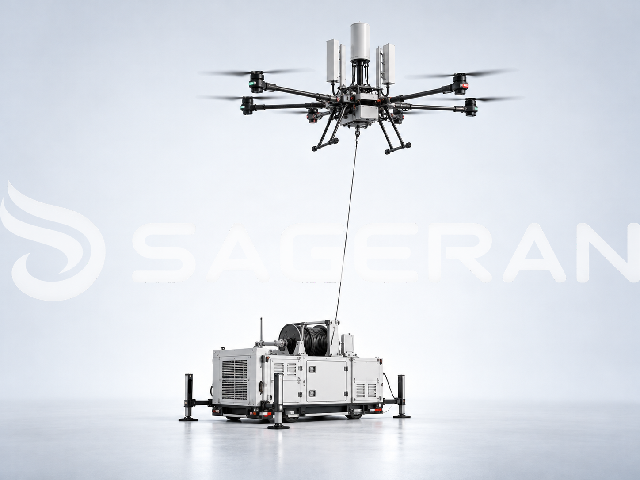
Tethered UAV communication systems combine an elevated cellular base station with a tethered drone platform.
Operating at altitudes of approximately 50–100 meters, the airborne base station extends wireless coverage over disaster-affected areas. Backhaul is typically provided through microwave or wireless bridge connections.
These systems offer relatively wide coverage and high capacity, making them a useful complement to vehicle-mounted emergency base stations.
2.3 Air-Dropped Emergency Base Stations
Air-dropped base stations are designed for rapid deployment into disaster zones that cannot be reached by ground vehicles.
A typical system integrates a high-power cellular base station, omnidirectional antennas, a satellite terminal, and a high-capacity battery pack.
Following deployment, the system can automatically position its satellite antenna, establish satellite backhaul, and configure the cellular base station for service activation.
SageRAN has developed and commercialized multiple portable and UAV-based 4G/5G emergency communication solutions. The company is also advancing the development of air-droppable base stations, with additional products under development.
2.4 Resilient Emergency Communication Sites
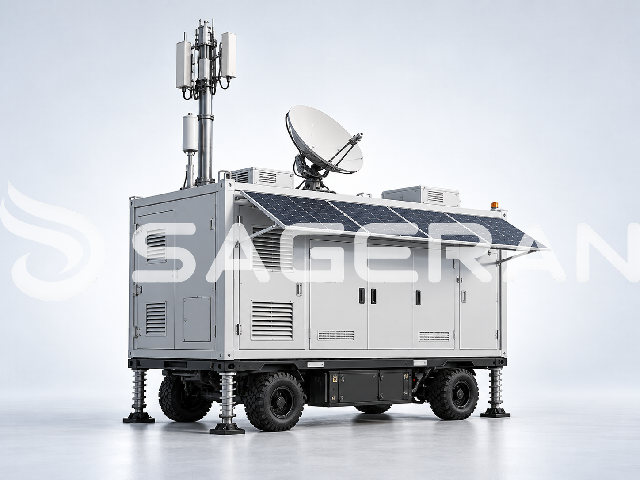
Resilient emergency communication sites are designed to maintain essential network services during major infrastructure failures.
These installations typically incorporate generators, battery backup systems, redundant fiber connections, high-gain satellite terminals, and high-power outdoor base stations.
The equipment shelters are engineered for improved seismic resilience. In situations involving simultaneous failures of grid power, terrestrial transmission links, and surrounding network infrastructure, backup power and satellite backhaul can help maintain critical cellular connectivity.
3.0 | The Next Frontier: Direct-to-Device Satellite Connectivity
The rapid development of commercial satellite constellations and Non-Terrestrial Networks (NTN) is creating new possibilities for emergency communications.
Emerging satellite IoT and NTN systems are extending connectivity beyond the reach of terrestrial networks, with some already supporting direct communication with compatible handheld devices.
SageRAN is actively developing NTN technologies to support the integration of satellite and terrestrial mobile networks.
Communication satellites incorporating SageRAN's NTN protocol stack are currently undergoing in-orbit testing, marking an important step toward commercial satellite-based mobile connectivity.
As NTN technology and compatible mobile devices continue to mature, direct-to-device satellite communications are expected to support voice, data, and emergency messaging services in areas without terrestrial coverage.
These capabilities will be particularly valuable in remote mountains, deserts, maritime environments, and disaster-affected regions.
By combining terrestrial 4G/5G infrastructure, rapidly deployable emergency base stations, and satellite connectivity, SageRAN aims to deliver more resilient communication solutions for emergency response and underserved environments.
Connecting people when terrestrial networks are unavailable.